Gastroenterology

Choledocholithiasis

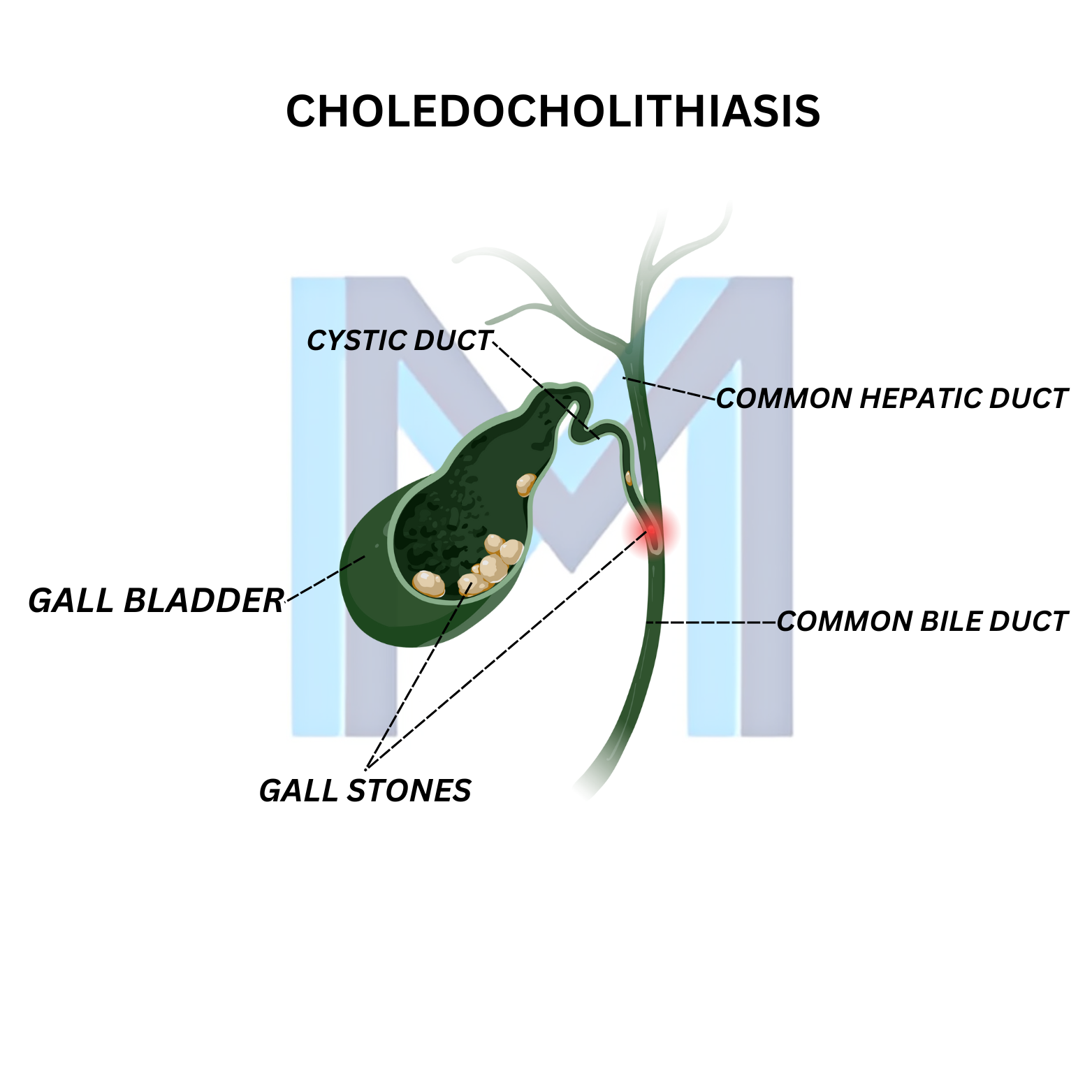
Gallstones in the common bile duct causing obstructive jaundice, ascending cholangitis and gallstone pancreatitis. Treated primarily with ERCP.

Last reviewed 13 Jun 2026 - MedicoMedics editorial team

Choledocholithiasis common bile duct stone with ductal dilation

Pathophysiology

Primary CBD stones form de novo in stasis (biliary strictures, parasitic infection); secondary stones migrate from the gallbladder. Obstruction raises intraductal pressure -> bacterial translocation from gut flora (E. coli, Klebsiella, Enterococcus) -> cholangitis.

Sources: ASGE Choledocholithiasis Guideline (Gastrointest Endosc 2019;89:1075); Tokyo Guidelines 2018 (J Hepatobiliary Pancreat Sci 2018;25:41); ACG Acute Cholangitis Overview (Am J Gastroenterol 2021 clinical update)

Clinical presentation

Right-upper-quadrant pain, obstructive jaundice (dark urine, pale stool, pruritus), Charcot triad (RUQ pain, jaundice, fever) for acute cholangitis; Reynolds pentad adds hypotension and altered mental status. Pancreatitis may coexist.

Diagnosis

LFTs: elevated ALP, GGT, direct bilirubin. Transabdominal US: dilated CBD >6 mm (>10 mm post-cholecystectomy). MRCP or EUS confirm stones with high sensitivity. High-probability criteria (CBD stone on US, bilirubin >4, CBD >6 mm + bilirubin 1.8-4): proceed directly to ERCP.

Management

ERCP with sphincterotomy and stone extraction (basket/balloon) is first-line; combined with laparoscopic cholecystectomy during the same admission for gallstone pancreatitis or symptomatic cholelithiasis. Acute cholangitis: Tokyo grading, broad-spectrum antibiotics (piperacillin-tazobactam), and biliary drainage within 24 h for moderate/severe grades.

Complications

Ascending cholangitis, gallstone pancreatitis, secondary biliary cirrhosis (chronic), post-ERCP pancreatitis (indomethacin PR reduces risk in high-risk patients).
Sample USMLE-style MCQs

Try 5 questions on this topic. Practice hundreds more free with a trial.

Question 1

A 55-year-old with RUQ pain, jaundice and fever (T 39 C). Bilirubin 6 mg/dL, ALP 4x ULN, CBD 12 mm on US. Best next step?

Question 2

Which imaging modality is best to detect CBD stones without invasive intervention?

Question 3

In a patient with mild gallstone pancreatitis who improves clinically, cholecystectomy should be performed:

Question 4

What is Reynolds pentad?

Question 5

Which drug reduces post-ERCP pancreatitis in high-risk patients?

References

Primary guidelines and peer-reviewed sources used for this entry. Reviewed 13 Jun 2026 by MedicoMedics editorial team.

  1. ASGE Choledocholithiasis Guideline (Gastrointest Endosc 2019;89:1075)
  2. Tokyo Guidelines 2018 (J Hepatobiliary Pancreat Sci 2018;25:41)
  3. ACG Acute Cholangitis Overview (Am J Gastroenterol 2021 clinical update)

Frequently asked

What is Charcot's triad?

Fever, jaundice and right upper quadrant pain - suggests acute cholangitis.

When should cholecystectomy be performed after ERCP?

During the same admission or within 2 weeks to prevent recurrence.

Which antibiotic prophylaxis reduces post-ERCP pancreatitis?

Rectal indomethacin 100 mg immediately before or after ERCP in high-risk patients.

Related conditions

High-yield topics students commonly study alongside Choledocholithiasis.

More in Gastroenterology

Ready to master this topic?

Get the full lecture, 500+ MCQs, and AI explanations with a 7-day free trial.