Pathophysiology
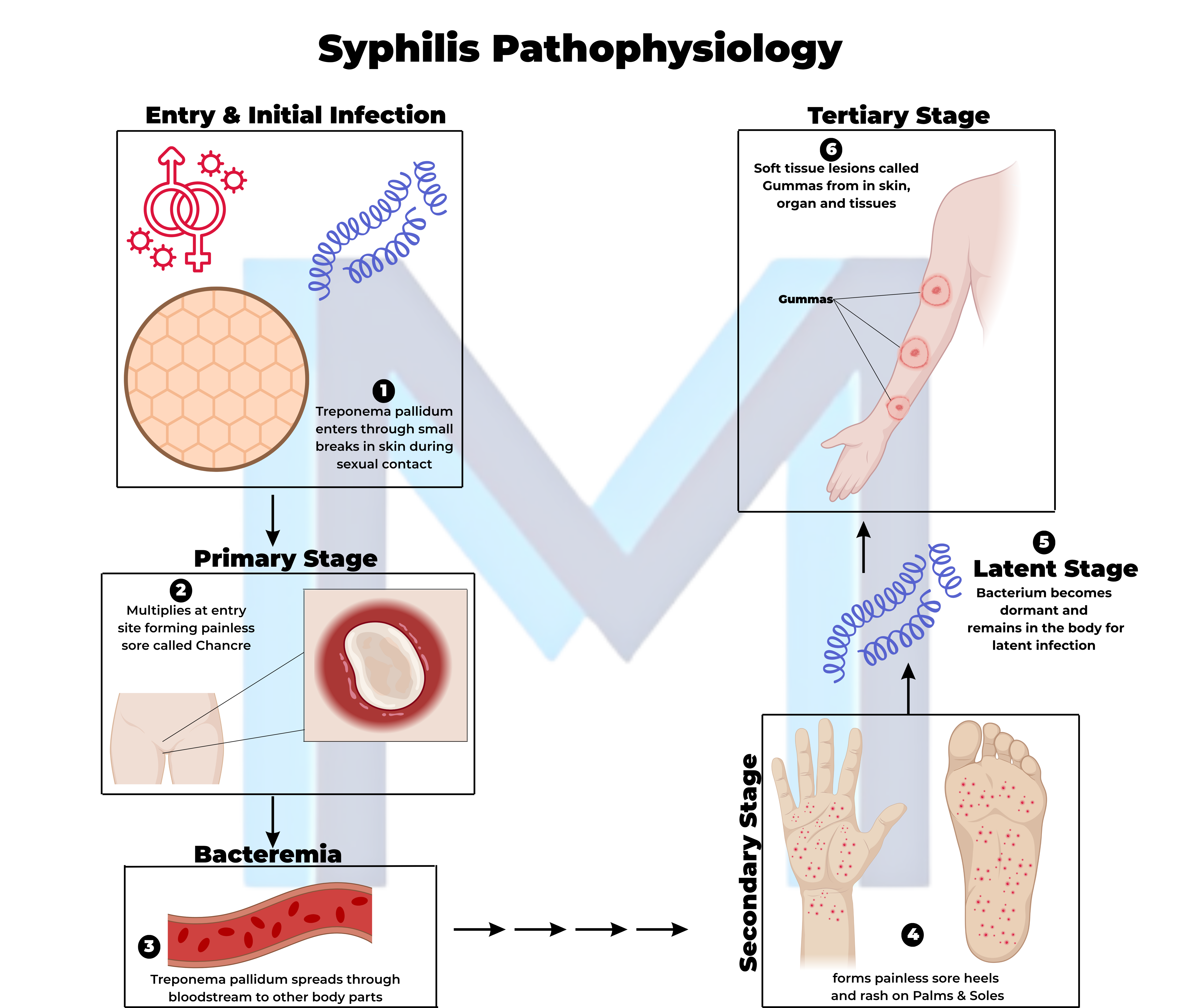
T. pallidum penetrates intact mucosa or abraded skin, disseminating haematogenously within hours. Endarteritis obliterans underlies most late complications.
Sources: CDC STI Treatment Guidelines (MMWR 2021;70(RR-4):1); IUSTI 2020 European Guideline on Syphilis Management; WHO Guidelines for the Treatment of Treponema pallidum (2016)
Clinical presentation
Primary: painless indurated chancre 3 weeks after exposure, resolving spontaneously. Secondary: diffuse rash including palms/soles, condyloma lata, mucous patches, generalised lymphadenopathy 4-10 weeks later. Latent: asymptomatic seroreactivity. Tertiary: gummas, aortitis, tabes dorsalis, general paresis (neurosyphilis).
Sources: CDC STI Treatment Guidelines (MMWR 2021;70(RR-4):1); IUSTI 2020 European Guideline on Syphilis Management; WHO Guidelines for the Treatment of Treponema pallidum (2016)
Diagnosis
Two-step serology: treponemal test (EIA, TP-PA) plus non-treponemal titre (RPR, VDRL) for activity and monitoring. Dark-field microscopy of chancre exudate confirms early disease. Lumbar puncture for suspected neurosyphilis, HIV coinfection with high RPR, or tertiary signs.
Sources: CDC STI Treatment Guidelines (MMWR 2021;70(RR-4):1); IUSTI 2020 European Guideline on Syphilis Management; WHO Guidelines for the Treatment of Treponema pallidum (2016)
Management
Primary, secondary, early latent: benzathine penicillin G 2.4 million units IM single dose. Late latent or unknown duration: three weekly doses. Neurosyphilis or ocular/otic syphilis: IV aqueous crystalline penicillin G 3-4 million units every 4 hours for 10-14 days. Desensitise penicillin-allergic pregnant patients. Follow-up RPR at 6 and 12 months (fourfold drop indicates treatment success). Report to public health and screen partners.
Sources: CDC STI Treatment Guidelines (MMWR 2021;70(RR-4):1); IUSTI 2020 European Guideline on Syphilis Management; WHO Guidelines for the Treatment of Treponema pallidum (2016)