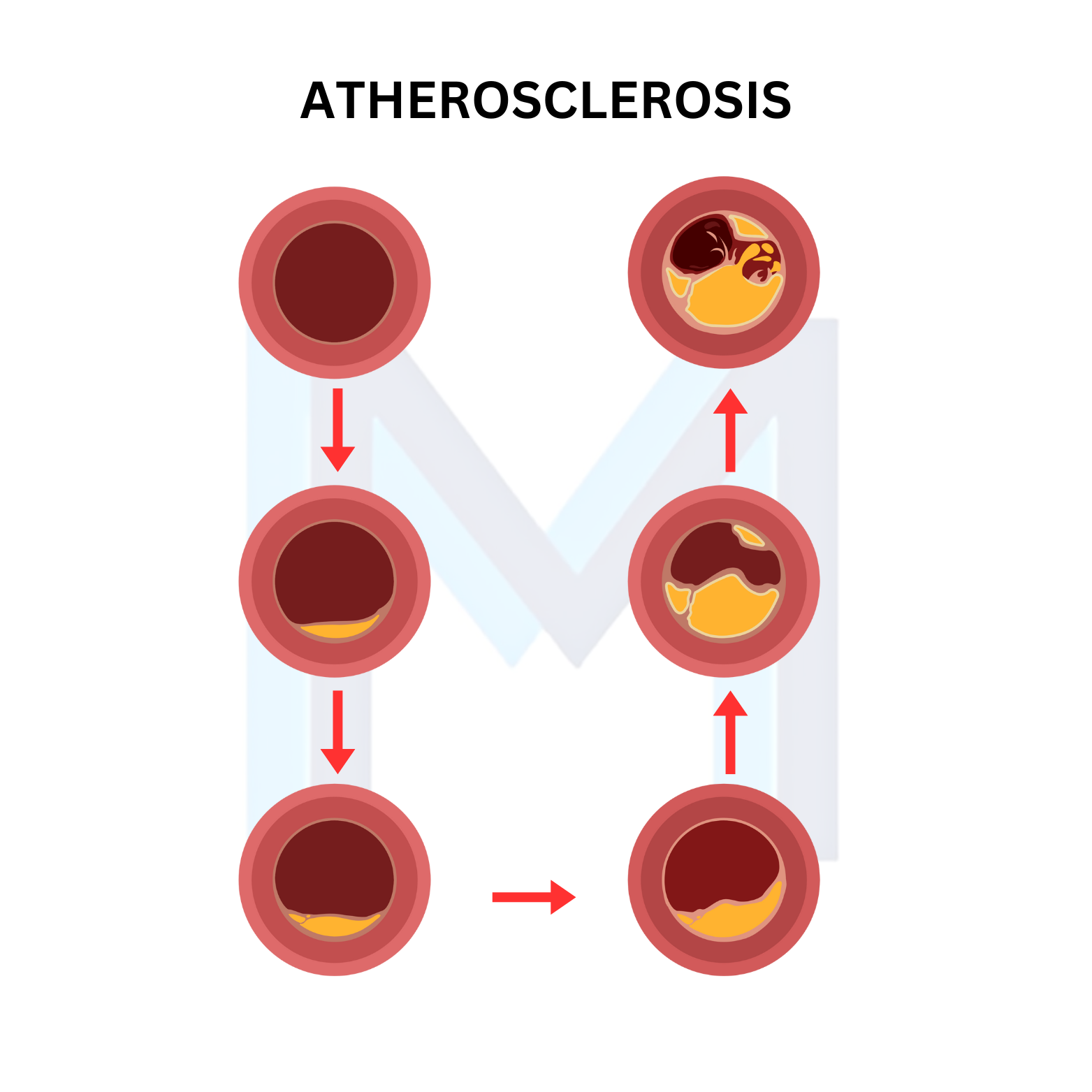
Pathophysiology
LDL enters intima, is oxidised, and taken up by macrophages forming foam cells. Chronic inflammation, smooth muscle migration and fibrous cap formation create atheromatous plaques. Plaque rupture exposes thrombogenic core, triggering platelet activation and coronary thrombosis.
Sources: AHA/ACC 2023 Chronic Coronary Disease Guideline (Circulation 2023;148:e9); ESC 2024 Guidelines on CCS (Eur Heart J 2024;45:3415); AHA/ACC/Multisociety Cholesterol Guideline 2018 (Circulation 2019;139:e1082)
Clinical presentation
Stable angina: exertional retrosternal pressure relieved within minutes by rest or nitrates, reproducible on similar exertion. Modified risk factors: smoking, hypertension, diabetes, dyslipidaemia, obesity; non-modifiable: age, male sex, family history.
Sources: AHA/ACC 2023 Chronic Coronary Disease Guideline (Circulation 2023;148:e9); ESC 2024 Guidelines on CCS (Eur Heart J 2024;45:3415); AHA/ACC/Multisociety Cholesterol Guideline 2018 (Circulation 2019;139:e1082)
Diagnosis
12-lead ECG (may be normal at rest). Functional testing: exercise ECG, stress echo, or nuclear MPI. Anatomical: coronary CT angiography for low-intermediate probability; invasive angiography with FFR/iFR when revascularisation likely.
Sources: AHA/ACC 2023 Chronic Coronary Disease Guideline (Circulation 2023;148:e9); ESC 2024 Guidelines on CCS (Eur Heart J 2024;45:3415); AHA/ACC/Multisociety Cholesterol Guideline 2018 (Circulation 2019;139:e1082)
Medical therapy
All patients: high-intensity statin, low-dose aspirin (secondary prevention), risk-factor optimisation. Anti-anginal: beta-blocker or calcium-channel blocker first-line; long-acting nitrate, ranolazine, ivabradine as add-ons. GLP-1/SGLT2 agents for diabetics.
Sources: AHA/ACC 2023 Chronic Coronary Disease Guideline (Circulation 2023;148:e9); ESC 2024 Guidelines on CCS (Eur Heart J 2024;45:3415); AHA/ACC/Multisociety Cholesterol Guideline 2018 (Circulation 2019;139:e1082)
Revascularisation
PCI for symptom relief and prognostic benefit in left main, three-vessel disease with high SYNTAX, or refractory symptoms. CABG preferred for complex three-vessel disease and diabetes with multivessel disease.
Sources: AHA/ACC 2023 Chronic Coronary Disease Guideline (Circulation 2023;148:e9); ESC 2024 Guidelines on CCS (Eur Heart J 2024;45:3415); AHA/ACC/Multisociety Cholesterol Guideline 2018 (Circulation 2019;139:e1082)