Pulmonology

Chronic Obstructive Pulmonary Disease (COPD)

Progressive, largely irreversible airflow limitation from chronic bronchitis and emphysema, driven predominantly by cigarette smoke. Bronchodilators, smoking cessation, oxygen and vaccination alter its course.

Last reviewed 25 May 2026 - MedicoMedics editorial team

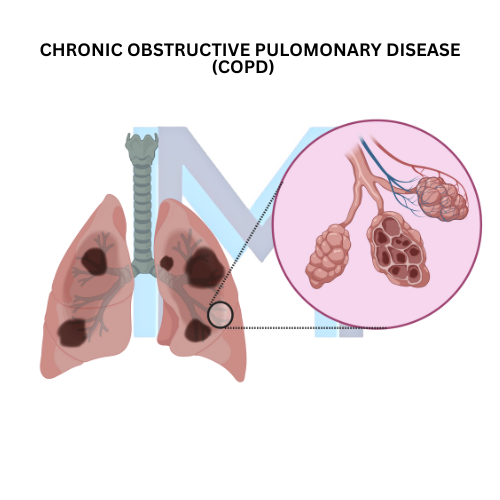
Emphysematous alveolar destruction and chronic bronchitis in COPD

Pathophysiology

Cigarette smoke recruits neutrophils, macrophages and CD8+ T cells that release elastase, matrix metalloproteinases and oxidants. This destroys alveolar walls (emphysema), causes goblet cell hyperplasia and mucus hypersecretion (chronic bronchitis) and drives small-airway fibrosis. Loss of elastic recoil collapses airways on expiration, trapping air (hyperinflation) and increasing work of breathing. Alpha-1 antitrypsin deficiency produces panacinar, basal emphysema in non-smokers.

Sources: GOLD 2025 Report; ATS/ERS Standards for spirometry (ERJ 2019;53:1900164)

Clinical presentation

Chronic productive cough, progressive dyspnoea, wheeze and exercise intolerance. Exam: barrel chest, prolonged expiration, pursed-lip breathing, distant breath sounds, hyperresonance. Advanced disease: cyanosis, cor pulmonale (peripheral oedema, elevated JVP), cachexia. Exacerbations present with increased dyspnoea, sputum volume and purulence.

Sources: GOLD 2025 Report; ATS/ERS Standards for spirometry (ERJ 2019;53:1900164)

Diagnosis

Post-bronchodilator FEV1/FVC <0.70 confirms fixed airflow limitation. GOLD stage by FEV1: 1 ≥80%, 2 50-79%, 3 30-49%, 4 <30% predicted. GOLD ABE groups combine symptom burden (mMRC/CAT) and exacerbation history. Screen for alpha-1 antitrypsin in early-onset, non-smoker, or basal emphysema.

Sources: GOLD 2025 Report; ATS/ERS Standards for spirometry (ERJ 2019;53:1900164)

Long-term treatment

Smoking cessation and pulmonary rehabilitation are the only interventions that alter mortality besides long-term oxygen for chronic hypoxaemia. Inhaled therapy: LAMA or LABA for group A/B, LAMA + LABA for group E; add ICS when eosinophils ≥300/µL or ≥2 moderate exacerbations. Vaccinate against influenza, pneumococcus, COVID-19, RSV and pertussis. Long-term O2 if PaO2 ≤55 mmHg or SpO2 ≤88% (or ≤59 mmHg with cor pulmonale/polycythaemia).

Sources: GOLD 2025 Report; ATS/ERS Standards for spirometry (ERJ 2019;53:1900164)

Exacerbation management

Controlled oxygen to target SpO2 88-92%, nebulised SABA + ipratropium, systemic corticosteroids (prednisolone 40 mg for 5 days), antibiotics if increased sputum purulence, NIV (BiPAP) for pH <7.35 with respiratory acidosis, intubation for refractory failure. Assess for pneumothorax, pneumonia, PE and heart failure as precipitants.

Sources: GOLD 2025 Report; ATS/ERS Standards for spirometry (ERJ 2019;53:1900164)
Sample USMLE-style MCQs

Try 10 questions on this topic. Practice hundreds more free with a trial.

Question 1

Which finding is required for a diagnosis of COPD?

Question 2

A 45-year-old non-smoker with basal panacinar emphysema and mildly elevated ALT should be evaluated for which disorder?

Question 3

A COPD patient (GOLD E) on LABA + LAMA has 2 exacerbations. Eosinophils 350. Next step?

Question 4

Which agent reduces COPD exacerbations via phosphodiesterase-4 inhibition?

Question 5

Which intervention has been proven to reduce mortality in COPD besides smoking cessation?

Question 6

A COPD patient with pH 7.28, PaCO2 65 mmHg despite controlled O2 and bronchodilators should next receive?

Question 7

Which biologic was recently approved for COPD?

Question 8

Long-term oxygen therapy criteria?

Question 9

When should ICS be added to LABA-LAMA in COPD?

Question 10

Alpha-1 antitrypsin deficiency treatment?

References

Primary guidelines and peer-reviewed sources used for this entry. Reviewed 25 May 2026 by MedicoMedics editorial team.

  1. GOLD 2025 Report
  2. ATS/ERS Standards for spirometry (ERJ 2019;53:1900164)
Frequently asked

What is the single most effective intervention in COPD?

Smoking cessation - it is the only therapy that clearly slows FEV1 decline and improves survival across all stages.

When is inhaled corticosteroid indicated?

Add ICS to LABA-LAMA if blood eosinophils ≥300 cells/µL or in patients with ≥2 moderate or 1 severe exacerbation per year. Avoid ICS alone.

What criteria qualify a patient for long-term oxygen?

PaO2 ≤55 mmHg or SpO2 ≤88% at rest, or ≤59 mmHg / 89% with signs of right heart strain or polycythaemia.

Why aim for SpO2 88-92% and not 100%?

Excess oxygen can worsen ventilation-perfusion mismatch and blunt hypoxic drive, precipitating hypercapnia and respiratory acidosis in chronic CO2 retainers.

Related conditions

High-yield topics students commonly study alongside Chronic Obstructive Pulmonary Disease (COPD).

More in Pulmonology

Ready to master this topic?

Get the full lecture, 500+ MCQs, and AI explanations with a 7-day free trial.