Pathophysiology
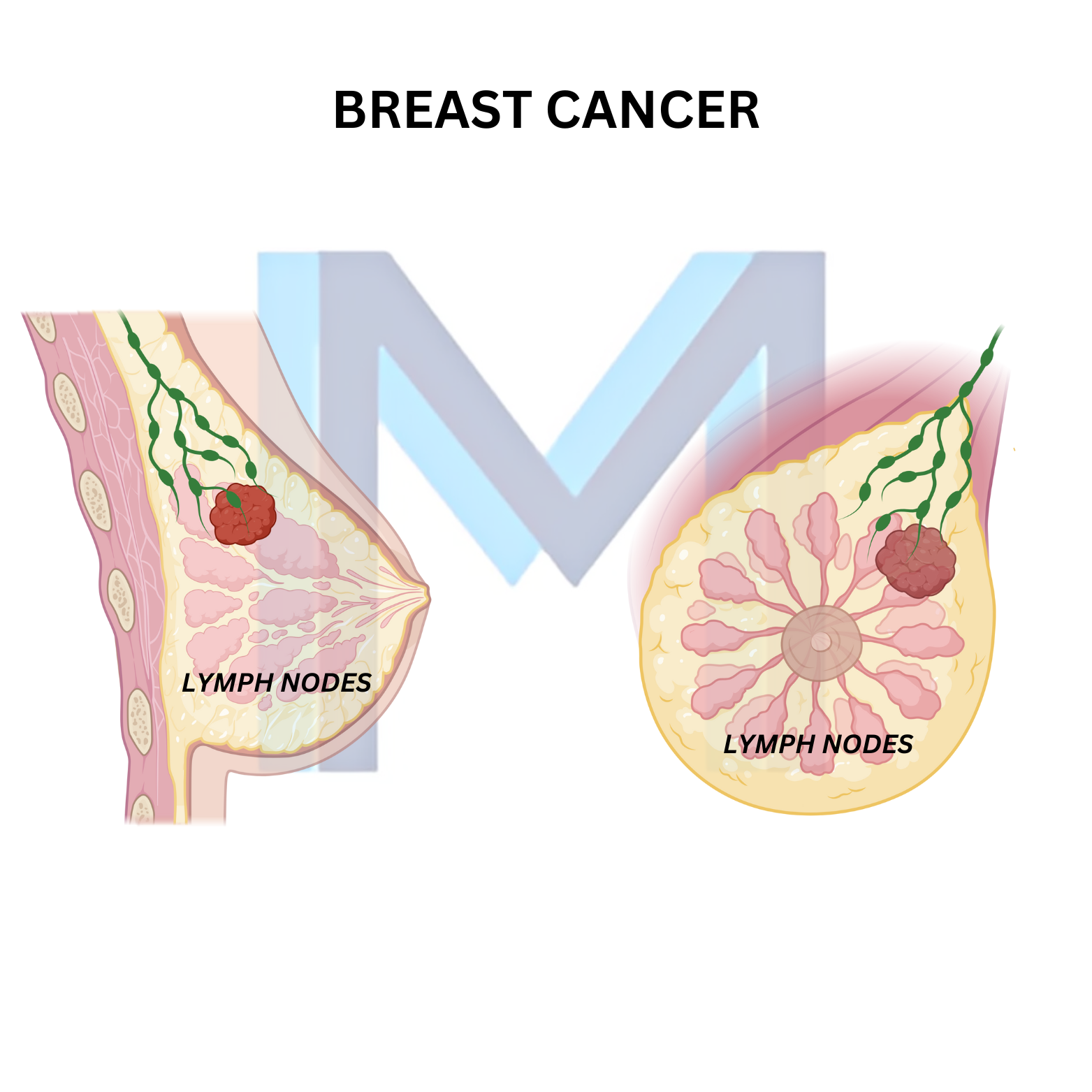
Malignant transformation of ductal or lobular epithelium. Major subtypes: hormone-receptor positive (luminal A/B), HER2-enriched, triple-negative. Germline BRCA1/2, PALB2, CHEK2 and TP53 mutations increase lifetime risk substantially.
Sources: NCCN Guidelines: Breast Cancer (v3.2025); USPSTF Breast Cancer Screening (JAMA 2024;331:1918); ESMO Early Breast Cancer Clinical Practice Guidelines (Ann Oncol 2023;34:1216)
Clinical presentation
Painless breast lump, skin dimpling, nipple retraction or discharge, peau d''orange, axillary lymphadenopathy. Inflammatory breast cancer: rapid erythema, oedema, and warmth without discrete mass.
Sources: NCCN Guidelines: Breast Cancer (v3.2025); USPSTF Breast Cancer Screening (JAMA 2024;331:1918); ESMO Early Breast Cancer Clinical Practice Guidelines (Ann Oncol 2023;34:1216)
Screening
USPSTF 2024: biennial mammography from 40-74 y for average risk. High risk (BRCA carriers, prior chest RT before 30 y, strong family history): annual MRI plus mammography starting earlier.
Sources: NCCN Guidelines: Breast Cancer (v3.2025); USPSTF Breast Cancer Screening (JAMA 2024;331:1918); ESMO Early Breast Cancer Clinical Practice Guidelines (Ann Oncol 2023;34:1216)
Diagnosis
Triple assessment: clinical exam, imaging (mammogram, targeted ultrasound, MRI for high-risk or dense breasts), and core-needle biopsy with ER/PR/HER2 and Ki-67. Staging: CT chest/abdomen/pelvis and bone scan for stage III+; consider genomic assays (Oncotype DX) for ER+ node-negative disease.
Sources: NCCN Guidelines: Breast Cancer (v3.2025); USPSTF Breast Cancer Screening (JAMA 2024;331:1918); ESMO Early Breast Cancer Clinical Practice Guidelines (Ann Oncol 2023;34:1216)
Management
Local: breast-conserving surgery + radiotherapy, or mastectomy +/- reconstruction; sentinel lymph node biopsy. Systemic: endocrine therapy (tamoxifen premenopausal, aromatase inhibitor postmenopausal, +/- CDK4/6 inhibitor) for HR+; trastuzumab/pertuzumab and antibody-drug conjugates (T-DM1, trastuzumab-deruxtecan) for HER2+; chemotherapy for triple-negative with pembrolizumab in high-risk cases; PARP inhibitors for BRCA-mutant.
Sources: NCCN Guidelines: Breast Cancer (v3.2025); USPSTF Breast Cancer Screening (JAMA 2024;331:1918); ESMO Early Breast Cancer Clinical Practice Guidelines (Ann Oncol 2023;34:1216)