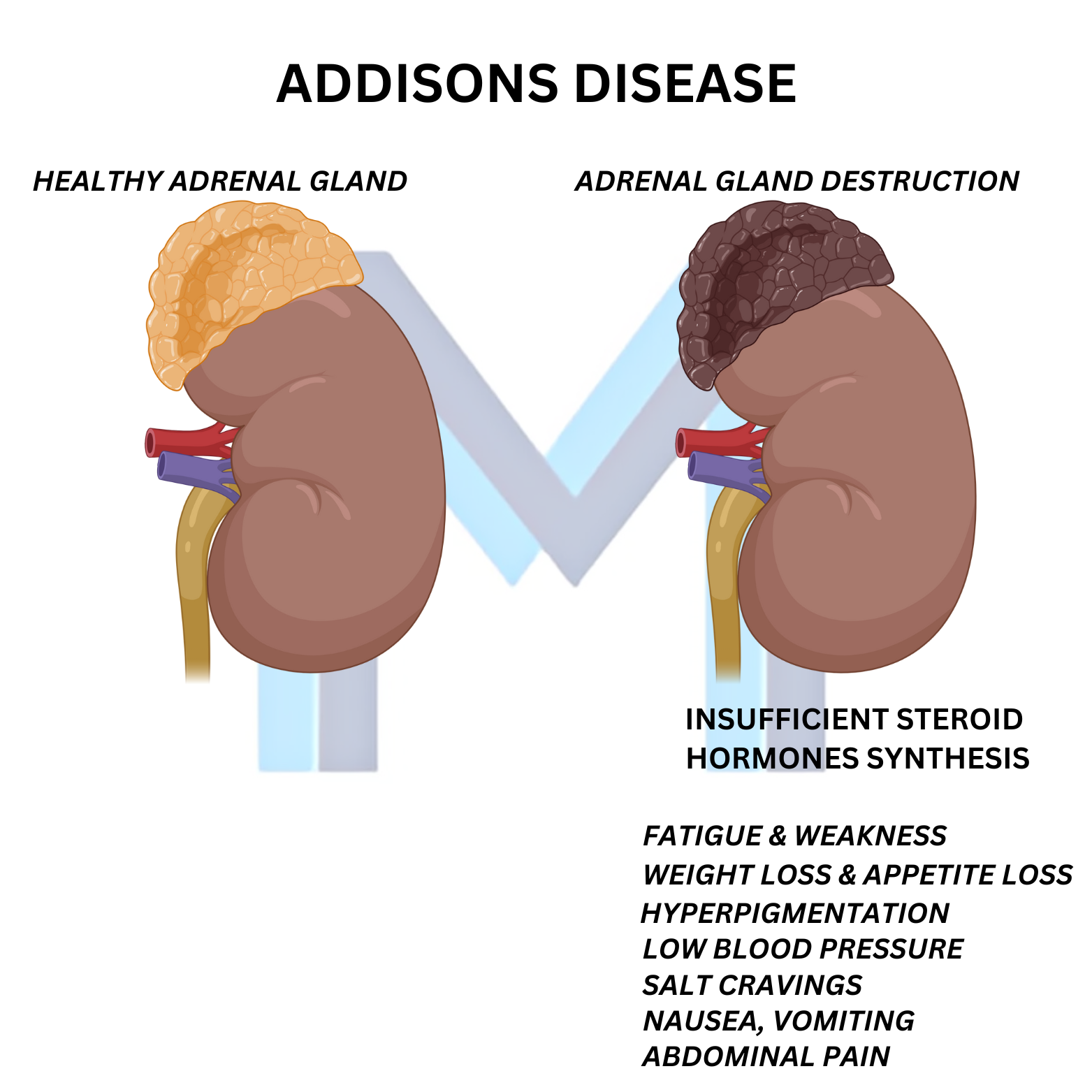
A patient comes in after three days of vomiting. They are dizzy on standing, their blood pressure is low, and the basic panel shows sodium of 126 mmol/L. The easy label is gastroenteritis with dehydration. But if they also mention months of fatigue, weight loss, and needing more salt on their food, stop and ask whether the adrenal glands have been keeping up.
Adrenal insufficiency is easy to miss because each symptom, by itself, is ordinary. It becomes less ordinary when you put the symptoms on a timeline 12.
Start with the axis
The hypothalamus releases CRH, the pituitary releases ACTH, and the adrenal cortex releases cortisol. ACTH is the pituitary's request for more cortisol. That gives you a useful two-question framework: is cortisol insufficient, and is the pituitary asking for more?
In primary adrenal insufficiency, the adrenal gland cannot answer. Cortisol falls and ACTH rises. Aldosterone may fall too because the adrenal cortex itself is damaged. In secondary insufficiency, inadequate pituitary ACTH is the problem; aldosterone is usually preserved because its main regulator is the renin-angiotensin system 1[3].
That distinction explains much more than a list of lab values ever could.
Why the clues cluster together
Without enough cortisol, the body struggles to maintain vascular responsiveness during illness. Patients feel weak, nauseated, and lightheaded; hyponatremia is common. In primary disease, aldosterone deficiency adds salt loss, volume depletion, and sometimes hyperkalemia 1.
High ACTH also drives melanocortin activity, causing hyperpigmentation - look at palmar creases, scars, and oral mucosa rather than relying on an overall impression of skin tone. This finding points toward primary disease, but its absence does not exclude it. The same goes for hyperkalemia: helpful when present, not a requirement 1.
There is another trap. Long-term glucocorticoid treatment can suppress the axis. A patient who recently stopped steroids may have secondary or tertiary adrenal insufficiency without the classic hyperpigmentation or potassium change 2. Ask about prescribed steroids, injections, and inhaled or topical preparations when the exposure has been substantial.
Testing when the patient is stable
An early-morning cortisol and paired ACTH are useful starting points. Results near the middle of the range do not settle the diagnosis. A short ACTH (cosyntropin) stimulation test checks whether the adrenal cortex can respond; interpretation depends on the local assay and clinical setting 12.
If primary insufficiency is confirmed, ask why. Autoimmune adrenalitis is a common cause in many settings, but infection, hemorrhage, infiltration, and other causes matter too. The history and examination guide that work-up. Do not order a scan before you have thought about the biochemistry 1.
When the patient is not stable
Adrenal crisis is a clinical emergency. Think of it when hypotension or shock comes with vomiting, abdominal pain, profound weakness, or altered consciousness, particularly during infection or after missed steroid doses. Draw cortisol and ACTH first if this can be done immediately, but do not delay treatment to obtain samples or wait for results. Give emergency parenteral hydrocortisone and fluid resuscitation according to local protocol, and treat the precipitating illness 12.
The distinction is worth saying plainly: a stimulation test belongs to the stable work-up, not the first minutes of an unstable patient's care.
What good follow-up looks like
Replacement is more than a daily prescription. People with confirmed adrenal insufficiency need clear sick-day instructions, emergency steroid access, and education on when oral medication is not enough, especially with persistent vomiting. Primary disease may also require mineralocorticoid replacement 12.
The useful habit for the ward is small: whenever "dehydration" does not quite explain the chronic story, revisit the axis. It takes one extra question about steroids or salt craving to change what happens next.