Every medical student has done this: opened a 400-page PDF at 9 p.m., highlighted half of it in yellow by midnight, and by Friday could not tell you which antibiotic covers pseudomonas. Rereading feels productive. It is not. What actually builds long-term memory is pulling information back out of your head, over and over, under a little bit of pressure 12. That is exactly the loop Medical Match was designed to run.
Today we are launching two things that push that loop even further: Duel Mode, a real-time head-to-head match against a classmate or a stranger from anywhere in the world, and Collaborative Review, a shared post-match room where the two of you sit down together and figure out why you got what you got wrong. This is the launch note - what it is, how to use it, and the reasoning (and research) behind why we think it is one of the strongest ways to study medicine on the internet right now.
What Medical Match actually is
Medical Match is the association game inside MedicoMedics. Each puzzle gives you a small set of medical concepts on the left - drugs, pathogens, syndromes, receptors, enzymes, imaging findings - and their partners on the right - side effects, treatments, mechanisms, complications, classic buzzwords. Your job is to connect each item on the left to the correct item on the right. Some puzzles are three lines. Some are twelve. Some are pure pharmacology, some are pure pathology, some deliberately mix systems so your brain has to work harder to disambiguate.
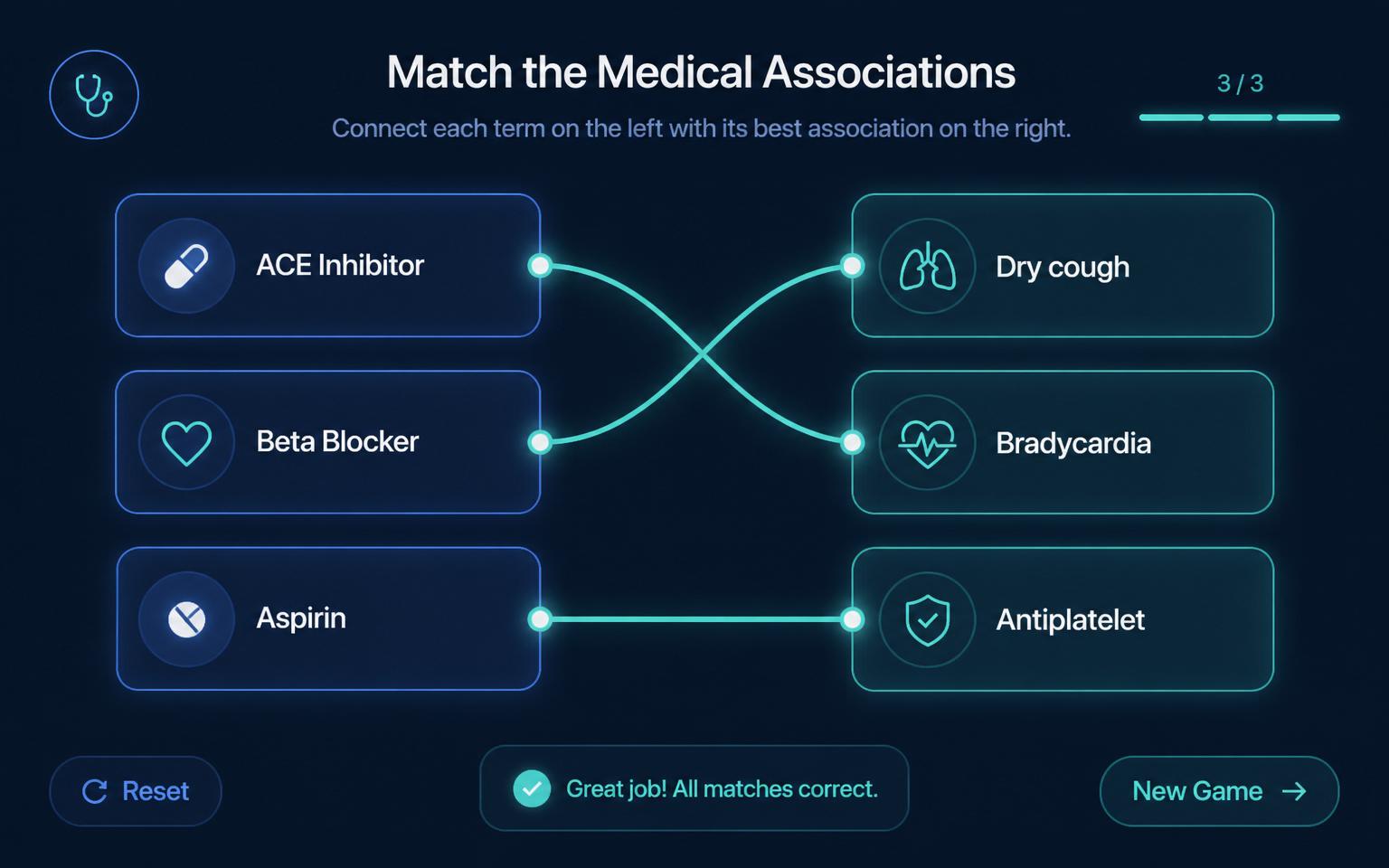
The game is small on purpose. A round is 60 to 120 seconds. It fits inside the walk to the hospital, the wait for a lecture to start, or the ten minutes you would otherwise spend on TikTok before bed. That size matters more than it looks - because short, spaced retrieval sessions outperform long cramming sessions on almost every measure the memory literature cares about 3.
Why the association format is not just a gimmick
There is a small clinical superpower hiding inside these puzzles. When you match "ACE inhibitor" to "dry cough", you are not memorising a fact - you are practising exactly the mental move you will make when a patient walks in with a persistent dry cough and a bottle of lisinopril in their bag. The direction of retrieval matches the direction of clinical thinking: symptom in, cause out; drug in, side effect out; pathogen in, treatment out.
That is why we did not build a passive flashcard app. Chi and Wylie's ICAP framework describes a clear hierarchy of learning: Passive is worst, then Active, then Constructive, and finally Interactive - and each step up delivers meaningfully better outcomes than the one below 4. Medical Match sits at the Interactive rung because you are forced to construct the link yourself, and Duel Mode pushes it further because you are constructing it against another human, in real time.
And the "active" part is not hand-waving. The largest randomised study of active vs traditional teaching in STEM, covering 225 studies and more than 150 university courses, found that failure rates dropped by roughly a third when passive lecturing was replaced with active engagement 5. Applied to medicine, that is the difference between reading about heart failure for an hour and losing most of it, versus doing five short retrieval bursts and remembering it a week later.
Duel Mode: two students, one puzzle set, real time
Here is what a duel looks like. You send an invite to a classmate (or hit "Quick match" and get paired with someone at a similar rating). The moment both of you accept, the server picks an identical shuffled set of puzzles and hands it to both boards simultaneously. A short countdown, and the round begins.
You see two things on screen: your board, and a small live progress bar for your opponent. You do not see their answers. You do not see their card positions. You only see how much of the round they have completed and their current score. That is deliberate - the pressure has to come from pace, not from copying.
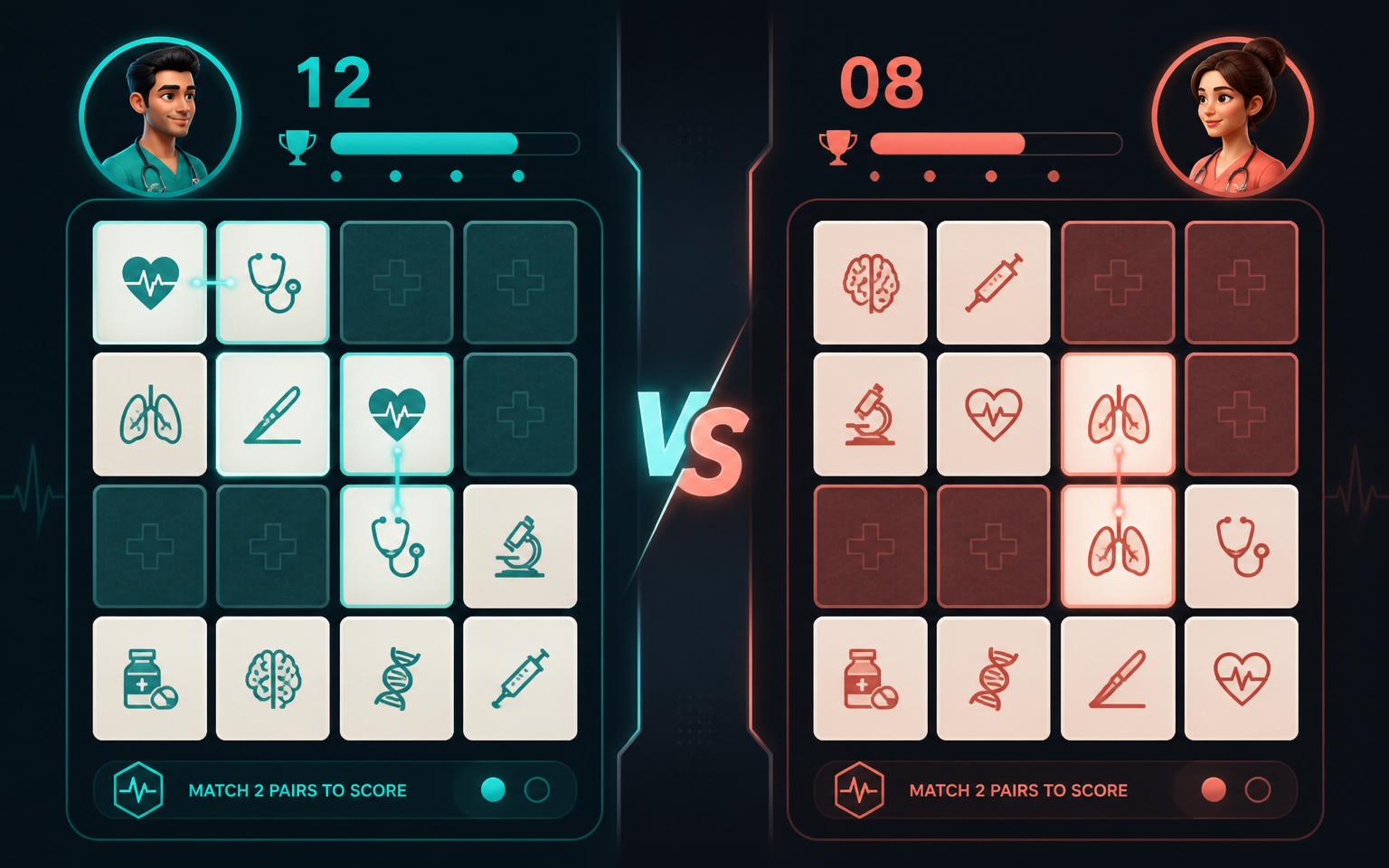
Scoring rewards accuracy first, speed second. Guessing is not free, but it is not punished so hard that you stop taking risks either. That balance is what keeps learners engaged instead of anxious 6.
After the match you get a rank and some XP. Ratings stay private unless you opt in to the leaderboards. That is really all you need to know before you play your first one.
### Why the head-to-head format works pedagogically
Two things happen inside your brain during a duel that do not happen during a solo puzzle.
- Time pressure forces automatic retrieval. When you have three seconds instead of thirty, you cannot deliberate your way to the answer - you either know the association or you do not. That is the condition under which memory traces get strengthened the most, and it is why timed retrieval outperforms untimed retrieval in almost every controlled study 12.
- Social presence increases effort. Even a symbolic opponent - a progress bar, a name at the top of the screen - reliably increases how hard people work on a task. A meta-analysis of gamified learning across 33 experiments found a small-to-medium positive effect on cognitive outcomes when competition was well-designed and voluntary 6. The trick is "well-designed" - which is why we made the review afterwards the real reward.
Collaborative Review: where the real learning happens
If a duel ended when the last card dropped, we would have built a nice game and not much more. What makes this feature actually valuable for medicine is what happens next.
When both players tap Review Together, the app opens a shared room built around the exact match you just played. Every puzzle appears in the middle, both of your answers sit side by side, and each card comes with a short explanation and a specific rationale for that association - why gentamicin belongs with "ototoxicity" and not with "nephrotoxicity alone", or why an S3 gallop belongs with "volume overload" and not with "high-output states".
There is a live chat pane on the side, and if you both hit a wall you can lean on Ask AI - scoped to the puzzle in front of you, not a general-purpose chatbot. Anything worth revisiting goes into a personal deck you can replay solo before an exam.
### Why reviewing with another human is worth the extra ten minutes
Peer learning is one of the most consistently supported findings in educational psychology. Topping's review of the field concluded that structured peer discussion improves both understanding and retention across a wide range of subjects, with the strongest effects when learners of similar level actively explain their reasoning to each other 7. You do not need to be a professor to teach medicine to another student - in fact, the "protege effect" suggests you learn best when you try to explain something to someone who is roughly at your level.
There is a second, more subtle mechanism. In a duel you learn what you got right and wrong. In a review you learn *why*. That "why" step is where isolated facts get promoted into the mental scaffolding you can actually use on a ward round.
A workable weekly rhythm with Medical Match
You do not need to overhaul your schedule. Slot it in like this:
- Weekdays: 3-5 solo puzzles per day, ideally spaced across morning, afternoon, and evening. Mix subjects so your brain has to switch contexts.
- Twice a week: one duel with a classmate on whatever subject you covered that week. Ten to fifteen minutes total.
- After every duel: open Collaborative Review together. Go through the missed puzzles, save the ones you both got wrong, and pick one shared weak subject to hit in the next duel.
- Weekends: replay the "Saved from duels" deck as a solo warm-up before your longer study block.
That is roughly 30 minutes of Medical Match per week. The point is not volume. The point is that every one of those minutes involves active retrieval, and roughly a third of them involve teaching or being taught by another person - which puts you at the top of the ICAP hierarchy where the biggest learning gains live 4.
What we deliberately did not build
We did not build "battle royale" mode. We did not build a chat that persists between strangers. We did not build a system that punishes losing streaks. We did not build any mode where speed can beat accuracy on medical content, because a fast wrong answer in medicine is worse than a slow right one.
What we did build is a small, focused loop: retrieve, compete a little, review together, save what stung, repeat. That loop is grounded in the strongest findings from the memory and active-learning literature we have, and it is designed to work whether you have three minutes between wards or thirty minutes on a Sunday morning.
Try it now
Open the Medical Match hub, tap Duel a friend, and send an invite to a classmate. Play three rounds. Then, whatever happens, tap Review Together. That is where the study session actually begins.
And if you find a puzzle that could be better - phrasing, edge case, ambiguous distractor - flag it inside the review room. Every flagged puzzle gets read by a human on our medical team. Medical Match gets better every week because of the people who play it.