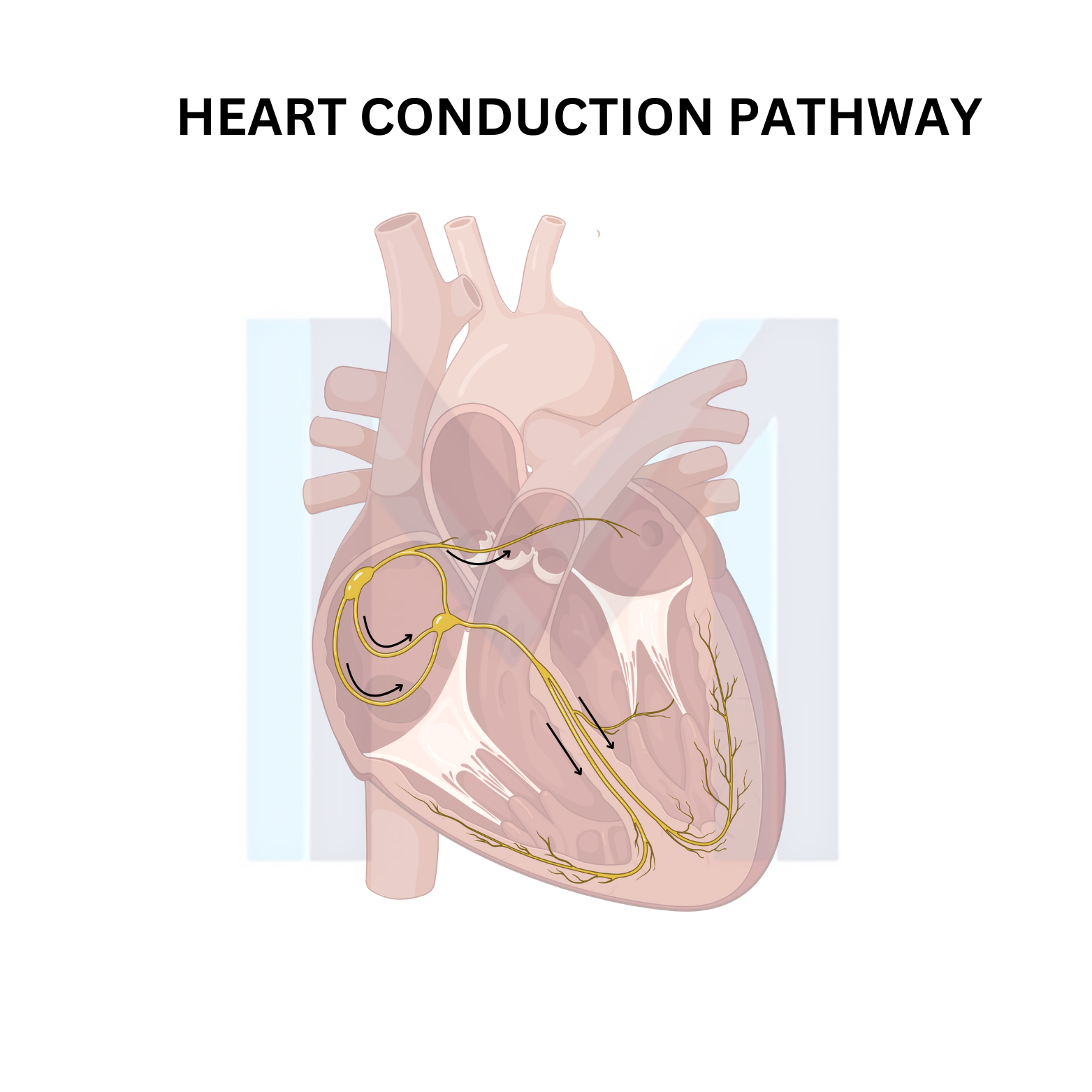
When I was a third-year, an ECG could ruin my afternoon. I would stare at the strip, see a few squiggles I half recognised, and wait for someone more senior to tell me what it meant. What changed everything for me was not a new textbook. It was a checklist. Eight steps, same order, every time, no matter how the strip looked. I have been running that same checklist for years, and it has not failed me at the bedside yet.
If you adopt it now, you will catch about 95 percent of what actually matters on a ward.
1. Rate, before anything else
If the rhythm looks regular, divide 300 by the number of big squares between two R waves. If it is irregular, count the QRS complexes in a 10-second strip and multiply by six. Normal sits between 60 and 100. Outside that range, the cause matters far more than the number itself.
2. Name the rhythm
Walk through three questions, in order. Is there a P wave in front of every QRS? Is there a QRS after every P? Is the PR interval the same beat after beat? Three yeses means sinus rhythm. Anything else needs a name, whether that is atrial fibrillation, flutter, an AV block, or ventricular tachycardia. Do not let yourself drift to step three until you have spoken a rhythm name out loud.
3. Axis, in two leads
Look only at leads I and aVF to start with.
- Both positive: normal axis.
- I positive, aVF negative: left axis deviation.
- I negative, aVF positive: right axis deviation.
- Both negative: extreme axis, and almost always pathological.
You can refine this later with lead II, but in 95 percent of strips the two-lead check is enough.
4. Intervals
The big three are PR, QRS, and QT. The standardisation document from the AHA/ACCF/HRS is the reference your seniors are quoting whether they say so or not 1.
- PR sits at 120 to 200 ms. Long means AV block. Short raises pre-excitation, classically WPW.
- QRS should be under 120 ms. A wide QRS points at a bundle branch block, a ventricular origin, or hyperkalaemia.
- QT must be corrected for rate. A long QTc kills people via torsades. The AHA's hospital prevention statement lists ondansetron, haloperidol, methadone and fluoroquinolones among the common offenders - recheck the QTc whenever you start one 5.
5. Hypertrophy
Four quick patterns to keep in your head:
- LVH by Sokolow-Lyon: the S in V1 plus the R in V5 or V6 is 35 mm or more.
- RVH: R wave taller than S in V1.
- Left atrial enlargement: a bifid P in lead II, the classic p mitrale.
- Right atrial enlargement: tall, peaked P in lead II, the p pulmonale.
6. Ischaemia
T-wave inversion in a coronary distribution suggests ischaemia. ST depression that is horizontal or downsloping by 1 mm or more is more specific. Subtle changes are still changes. Anchor everything you see back to the patient in front of you: their pain, their risk factors, the story they came in with.
7. Infarction
The current ESC ACS guideline (2023) and the AHA standardisation criteria agree: new ST elevation at the J point in two contiguous leads is a STEMI - at least 1 mm in most leads, with the higher V2-V3 cutoffs noted above 12. Treat it as one until someone proves otherwise.
Territories worth memorising:
- V1 to V4: anterior, LAD.
- I, aVL, V5, V6: lateral, LCx.
- II, III, aVF: inferior, RCA.
Always glance at the reciprocal leads. Their depression is what locks in the diagnosis. In inferior STEMI, add right-sided leads (V3R, V4R) to catch RV involvement before you give nitrates 2.
8. The patterns you cannot afford to miss
These are the ones that kill patients at 3 a.m. when you are tired. Burn them into memory now, while you have the time.
- Wellens' syndrome: biphasic or deeply inverted T waves in V2 and V3 in a patient who is currently pain-free. The LAD is about to occlude.
- De Winter T waves: upsloping ST depression with tall, symmetrical T waves across the precordial leads. Originally described in NEJM in 2008, it represents a proximal LAD occlusion and should be triaged like a STEMI 3.
- Brugada pattern: coved (type 1) ST elevation in V1-V2, originally described by the Brugada brothers in 1992 and still a recognised cause of sudden cardiac death in structurally normal hearts 4.
- Long QT: torsades waiting to happen.
- Hyperkalaemia progression: peaked T waves, then a widening QRS, then the sine wave. Treat before the rhythm collapses, not after.
A practice plan that actually works
Read five ECGs a day for 60 days. Set a 90-second timer for each. Write a one-line interpretation before you look at the answer. You will not be an expert at the end of the two months, but you will be safe, and safe is the bar you have to clear before you graduate.
One last thought
ECG mastery is less about pattern recognition than people think. It is about running the same eight-step routine even when the strip looks obvious. The obvious ECG is the one that catches you out. Trust the method, especially when you do not feel like you need it.